
Framework
Enterprise Software Layer Model
A practical model for deciding where AI work belongs, which system stays authoritative, what commits action, and what evidence proves the result.
Most AI demos avoid the part that decides whether the work can survive production.
The model may answer the question. The agent may draft the response. The workflow may look clean in a conference room. Then someone asks where the customer record gets updated, who approved the refund, which definition of margin was used, or what evidence proves policy was followed.
That is where enterprise AI stops being a demo and starts becoming an operating problem.
The Enterprise Software Layer Model is a practical way to place AI work inside the systems a company already runs. It separates the official record, the data estate, the runtime, the business meaning, the model judgment, the workflow action, and the controls that have to hold the result together.
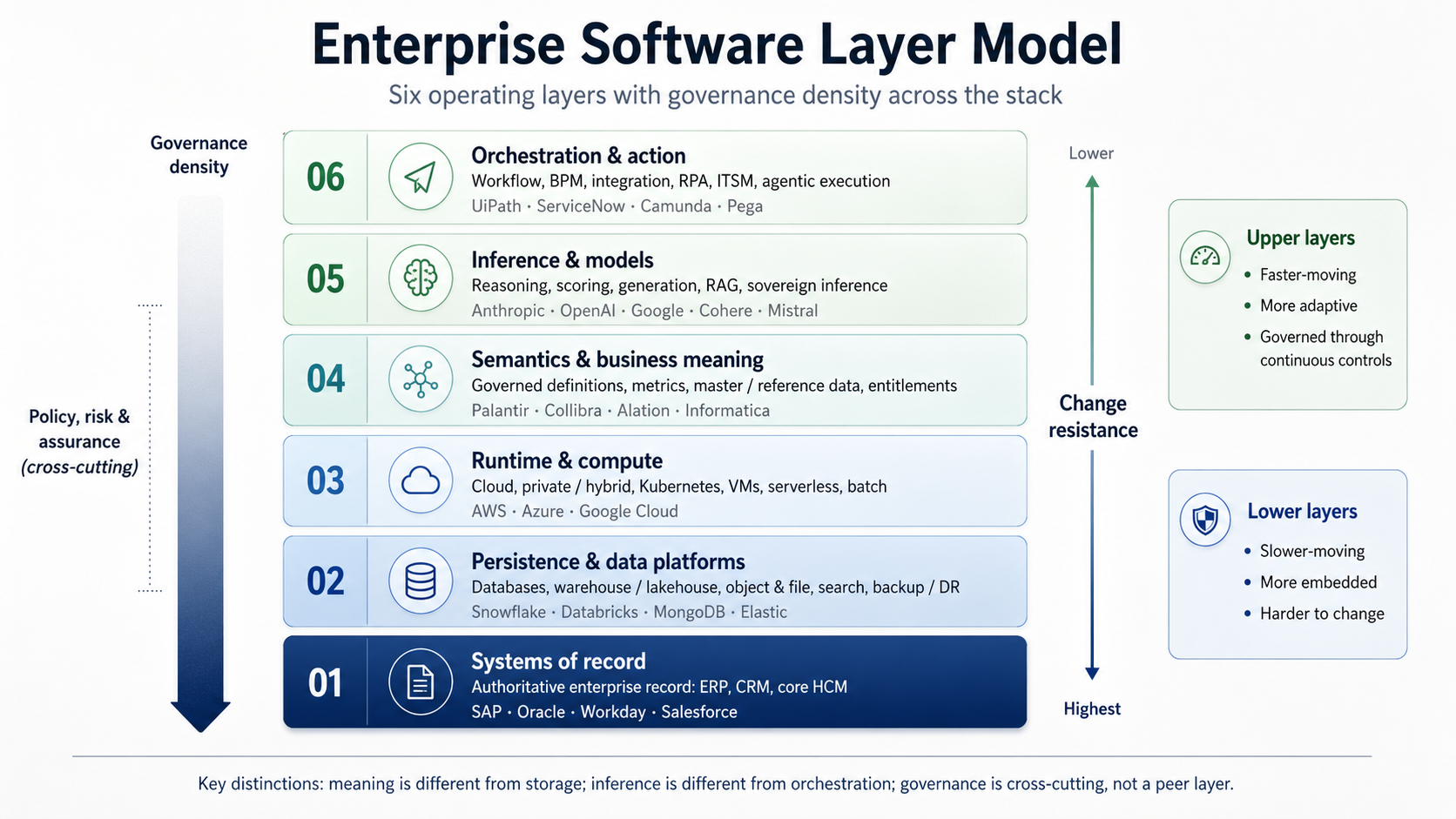
Use the model to decide which system owns the record, which layer supplies meaning, where AI judgment becomes action, and what evidence proves the workflow should be trusted.
What is the Enterprise Software Layer Model?
The Enterprise Software Layer Model is a management map for enterprise AI architecture. It helps leaders decide where AI-enabled work belongs before a use case moves from prototype to production.
It is not trying to be a perfect technical taxonomy. It is meant to make better questions unavoidable for a CIO, operator, investor, software vendor, or services partner.
The question is not only, “Can AI do this?” The better question is: where does this work sit, what does it depend on, and what happens if it is wrong?
Why enterprise AI needs a layer model
Enterprise AI does not float above the business. It still has to respect records, APIs, permissions, definitions, contracts, approvals, exception paths, and support models.
The problem is that these parts of the enterprise move at different speeds. A support-agent prompt can be tuned this week. A finance workflow may wait for a release cycle. A definition of margin may require agreement across finance, sales, operations, and legal. An audit control does not care how impressive the demo was.
A layer model keeps teams honest. It shows which parts can move quickly and which parts are slow because the business needs them to be authoritative, controlled, and hard to unwind.
What are the layers in enterprise AI architecture?
The model has six operating layers, with governance running across all of them.
| Layer | What lives here | Why it matters |
|---|---|---|
| Systems of record | ERP, CRM, HCM, finance, customer, service, and operational records | This is where official business facts live. These systems are authoritative, expensive to unwind, and hard to change for good reasons. |
| Persistence and data platforms | Warehouses, lakehouses, databases, indexes, replicas, logs | Data access improves here, but access is not the same as trusted business meaning. |
| Runtime and compute | Cloud, containers, serverless, batch jobs, integration runtime | This is where workloads run, scale, fail, recover, and get monitored. |
| Semantics and business meaning | Metrics, definitions, master data, lineage, entitlements, business rules | This layer tells the AI what the data means and whether it is allowed to use it. |
| Inference and models | LLMs, retrieval, scoring, classification, prediction, generation | This layer produces judgment: answers, summaries, recommendations, scores, drafts, or decisions for review. |
| Orchestration and action | Workflow, case management, approvals, integration, write-back, exception handling | This is where work gets routed, committed, audited, and supported. |
Governance is not a seventh box that sits neatly at the top. Governance shows up across the stack as permissions, policy, review, logging, monitoring, evidence, risk acceptance, and ownership.
How do AI agents work with systems of record?
AI agents usually do not replace systems of record. They change where work happens around them.
SAP, Oracle, Salesforce, ServiceNow, Workday, and other enterprise platforms may still hold the official record. That does not mean users will spend their day in those screens. Work may move into agents, workflow tools, collaboration surfaces, portals, or industry-specific applications that sit above the record.
That shift creates an obligation. If an AI workflow changes a customer, employee, order, refund, service commitment, forecast, or financial fact, the team has to know which system remains official and how the result writes back.
If nobody can answer that, the use case is still a prototype.
What is the difference between inference and orchestration?
Inference produces a judgment. Orchestration commits work.
A model can summarize a customer issue, classify a ticket, draft a response, recommend a next action, or predict churn. That is useful, but it is not the same as changing the business. The operating question starts when a recommendation crosses into action.
Once the workflow updates a record, triggers a refund, dispatches a field resource, changes an entitlement, or commits a forecast, orchestration becomes the main problem. Now the enterprise needs approvals, tool permissions, idempotency, exception handling, audit logs, and production support.
A demo can blur that line. A production system cannot.
Why business meaning is different from data access
A model can retrieve the right field and still misunderstand the business.
That happens when the semantic layer is weak. The data may be available, but the approved definition, lineage, entitlement, freshness, or policy boundary may be unclear. The AI system can sound confident while using a metric the business would not trust in a real decision.
The test is simple: before an AI workflow uses a field, metric, customer segment, product category, or policy rule, someone should be able to say what it means, who approved it, who may use it, and whether it is current enough for the decision.
Where does governance belong in enterprise AI?
Governance belongs inside the work, not only in a committee deck.
That does not mean every AI feature needs the same control regime. A low-risk summarization tool does not need the same governance as an agent that updates a financial forecast or changes a customer refund. The control model should match the operational consequence.
For production AI, governance usually means:
- who can use the workflow
- what data the AI can read
- what tools the AI can call
- what actions require approval
- what gets logged
- what evidence is retained
- what exceptions go to a human
- who owns the result after launch
The human in the loop still needs a control model. A reviewer without policy, evidence, or authority is just a speed bump with liability.
How should leaders use the model before production?
Use the model as a production-readiness check before funding, scaling, or handing a use case to a delivery partner.
Before an AI workflow goes live, leaders should be able to answer seven questions:
- What business result is supposed to improve: revenue, savings, margin, risk, customer experience, adoption, or decision quality?
- Which system owns the authoritative record?
- Which layer supplies the data?
- Which layer supplies the business meaning?
- Is the AI producing judgment, committing action, or both?
- What approval, write-back, exception, and evidence path is required?
- Who owns production support after launch?
If those answers are vague, the project is not ready for production. It may still be a useful experiment. Treat it that way.
Where enterprise AI programs break
Enterprise AI programs rarely fail because the model cannot produce a plausible answer. They fail because the organization has not designed the operating system around that answer.
Common failure points include:
- the system of record is unclear
- the business definition is disputed or undocumented
- the model recommendation becomes action without an approval path
- write-back is treated as a technical integration task instead of a control point
- the human reviewer has responsibility without evidence or authority
- the delivery partner builds the demo, but nobody owns production support
- the governance team reviews policy after the workflow has already shaped behavior
These are not academic architecture issues. They decide whether AI improves customer experience, reduces cost, protects revenue, raises margin, improves decisions, or creates new operational risk.
What should executives and investors inspect?
Executives and investors should inspect the seams between layers.
The seams are where the market story becomes operational reality. Ask where the record lives, where the work happens, where business meaning is approved, where model output becomes action, and where evidence is captured. That is usually where the risk sits. It is also where durable value gets created.
For diligence, the key question is not whether a company has AI projects. The question is whether AI changes revenue quality, delivery margin, customer retention, risk control, or decision speed in a way the operating model can sustain.
Enterprise Software Layer Model FAQ
What is the Enterprise Software Layer Model?
The Enterprise Software Layer Model is a practical way to map enterprise AI work across systems of record, data platforms, runtime, business meaning, inference, orchestration, and governance. It helps leaders decide where authority lives, where work happens, and what controls prove the result.
Do AI agents replace systems of record?
Usually no. AI agents may change where work happens, but systems of record still hold authoritative business facts such as customers, orders, inventory, employees, invoices, and financial postings.
Why is inference different from orchestration?
Inference produces a judgment, recommendation, prediction, classification, summary, or draft. Orchestration routes work, applies policy, manages approvals, writes back to systems, handles exceptions, and preserves evidence.
Where does governance belong in enterprise AI architecture?
Governance belongs inside the workflow and across the stack. Production AI needs permissions, logging, human review, tool controls, policy enforcement, exception handling, evidence, and ownership, not only a review board or dashboard.
Practitioner takeaway
Fast AI work still depends on slower systems that were built to be authoritative, controlled, and hard to unwind.
The answer is not to make every AI project move at ERP speed. The answer is to place the work in the right layer, define the handoffs between layers, and make ownership, controls, and evidence explicit before the workflow changes the business.